
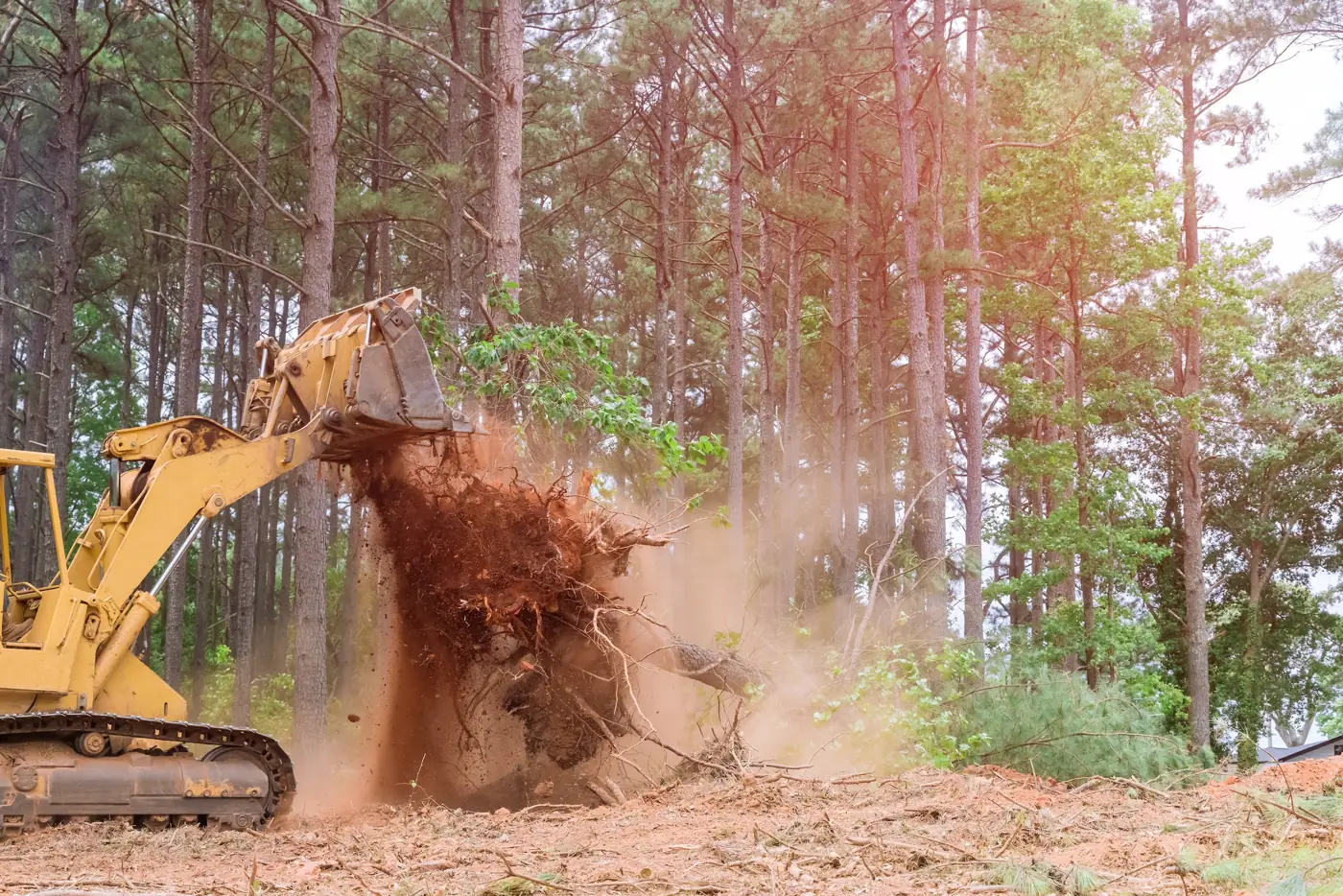
How much does land clearing cost in South Carolina?
Published cost guides put land clearing at $500 to $2,000 per acre when the land is lightly wooded. Heavily wooded land runs $3,000 to $5,600 per acre. Brush with few trees costs less, and forestry mulching runs $400 to $600 per acre. Stumps, slope, wet ground and the debris decide where a South Carolina acre lands.
Every cost figure here comes from published cost guides and from state and county rules. The guides publish national ranges, so local ground and local rules matter as much as the tables. We see the ground before we put a number on land clearing for wooded lots and raw acreage. The estimate is free.
What do published guides say land clearing costs per acre?
Three national guides publish similar ranges. Bob Vila puts lightly wooded land at $500 to $2,000 per acre and heavily wooded land at $3,000 to $5,600. Lawn Love puts the same two at $580 to $2,100 and $3,300 to $5,600. Fixr puts wooded land at $500 to $5,000 per acre, depending on tree density.
| What is on the land | Published cost per acre | Guide |
|---|---|---|
| Brush only | $330 to $630 | Lawn Love |
| Brush only | $20 to $200 | Bob Vila |
| Lightly wooded | $580 to $2,100 | Lawn Love |
| Lightly wooded | $500 to $2,000 | Bob Vila |
| Heavily wooded | $3,300 to $5,600 | Lawn Love |
| Heavily wooded | $3,000 to $5,600 | Bob Vila |
| Wooded, light to heavy | $500 to $5,000 | Fixr |
| Forestry mulching | $400 to $600 | Fixr, Bob Vila |
| Forestry mulching | $450 average | Lawn Love |
The trees drive the spread. Lawn Love figures that clearing a lot with fewer trees is 3 to 6 times cheaper.
Some crews bill by the hour instead of by the acre. Lawn Love puts that at $120 to $265 an hour, and Fixr at $110 to $250. Lawn Love warns that hours build up quickly on difficult land, so ask how each bid is priced.
What does it cost to clear a lot for a house?
A house lot is often a fraction of an acre, so the total comes down with the size. Bob Vila puts a lightly wooded quarter acre at $125 to $500. A heavily wooded quarter acre runs $750 to $1,400. Lawn Love puts half an acre at $405 to $2,935, depending on the land.
| Lot size | Lightly wooded | Heavily wooded |
|---|---|---|
| Quarter acre | $125 to $500 | $750 to $1,400 |
| Half acre | $250 to $1,000 | $1,500 to $2,800 |
| One acre | $500 to $2,000 | $3,000 to $5,600 |
| Two acres | $1,000 to $4,000 | $6,000 to $11,200 |
All figures in this table come from Bob Vila’s cost guide.
Stumps are the line to check on a house lot. Lawn Love warns that basic clearing may not include stump removal. It lists stumps at $130 to $350 each, and Bob Vila puts them around $345 each. If you plan to build, Lawn Love notes the stumps need to come out with all their roots.
Bob Vila says most cleared land needs grading before a house goes up. It puts that work at $500 to $7,700. On most house lots, grading the cleared ground into a building pad is the step that follows the clearing.
Is forestry mulching cheaper than clearing with a dozer?
It can be, per acre. Fixr and Bob Vila put forestry mulching at $400 to $600 per acre. Lawn Love puts the average at $450 and calls it cheaper than standard land clearing. Bob Vila lists mulching as a cost on top of tree and brush clearing, so read what each bid covers.
Mulching runs on one machine that turns trees and bushes into mulch spread across the ground. Lawn Love adds that there are no trees to pile and no waste to remove. That is where the savings come from.
A dozer job works the other way. The dozer pushes the trees over, and an excavator digs out the stumps and root balls. The piles leave the lot and bare dirt stays. By Lawn Love’s numbers that costs more per acre, but it is ground a builder can use.
What moves the number on a Midlands tract?
Tree density sets the base price, and acreage multiplies it. After that, stumps, slope, wet ground, access and the debris plan decide where a Midlands job falls. Two tracts the same size can end up at opposite ends of the published range for those reasons alone.
Trees and stumps. A heavily wooded acre costs several times what a lightly wooded acre does. Woods that were logged before clear faster, and each big stump is its own dig.
Acreage and time. Lawn Love says a crew can clear two to four acres a day on flat, open ground. Heavily wooded or sloped ground can take a full day or more per acre.
Slope and access. Lawn Love notes that steep ground is harder for machines to reach, which raises the cost. A tri axle dump truck and trailer also need room to turn around.
Clay or sandy ground. The Columbia area sits on the fall line. Lots run from loose sandy Sandhills soil to heavy red clay that holds water. After a wet week, clay turns to mud and machines cut deep ruts, so clay jobs wait on the weather.
The debris. Ask every bidder where the wood goes. Lawn Love notes that some crews burn it or take it away as part of the job. Others just pile it up on your property. The wood can be burned under the state rules, ground on site or loaded out to the landfill.
The Lexington County landfill fee schedule lists clean yard debris that is not mixed at $29 a ton. Yard waste mixed with other debris runs $38 a ton, $9 more. Large truckloads of land clearing material pay those tipping fees. Contractor loads go to the landfill itself instead of the county collection centers.
On our jobs, the debris is loaded out on our own trucks. It goes to the landfill as part of the job. Wood kept free of trash and fence wire stays at the clean rate.
Which South Carolina and Lexington County rules change the cost?
Two sets of rules move the price. Stormwater permits start once a job disturbs one acre or more. The state’s burn rules decide whether burning the debris is an option at all. Under one acre, a Lexington County home site not part of a larger plan needs no land disturbance permit.
SCDES requires construction stormwater permit coverage for one acre or more of land disturbance. Lexington County issues that coverage under delegated authority. A single family home site disturbing an acre or more needs a Single Family Residential Land Disturbance Permit.
Under one acre, an erosion control form goes in with the building permit instead. At 2 acres or more, SCDES requires a stormwater pollution prevention plan prepared by a licensed professional. That plan is a cost of its own. On a big tract, clearing only the house site and the drive can keep the work under one acre.
Burning has its own rules under the state’s open burning regulation. Outside mostly residential areas, a land clearing burn has to sit at least 1,000 feet from public roadways. The same goes for homes and businesses that are not on the property. That distance is hard to find on a small tract that fronts a road.
Only material cleared on that property may be burned there. No more than two 30 by 30 foot piles may burn within a six acre area at once. Salvageable timber and pulpwood must come off the tract first. That wood can be sold, and Lawn Love notes consultants usually take 5% to 20% of the selling price.
Can I burn the debris myself?
Sometimes, if your tract meets the state rules. Outside town limits, next to woods, brush or grassland, you must notify the SC Forestry Commission before the burn. The fire can only be started between 9:00 a.m. and 3:00 p.m. Nothing gets added between 3:00 p.m. and 9:00 a.m.
Inside town or city limits, the state notification law does not apply. Town ordinances may still regulate burning, so call the town before you light anything.
An old house or shed on the land is a different matter. Structural burns are prohibited under the state’s open burning regulations. Tearing down an old house or barn first is a separate job from the clearing.
How do you get a real number for your land?
The published ranges are wide because tracts differ so much. A real number comes from seeing the trees, the stumps, the slope and the way in. Dirt Cheap is family and woman owned, with a shop on Edmund Highway in West Columbia.
We clear land with full size CASE excavators and dozers within about 50 miles of the shop. Once the ground is open, the same machines handle digging footings and utility trenches.
Ali Jenkinson put it this way in a review: “Great communication, great price, would work with them again.” Estimates are free, so call (803) 796-4727 and tell us where the land is.