
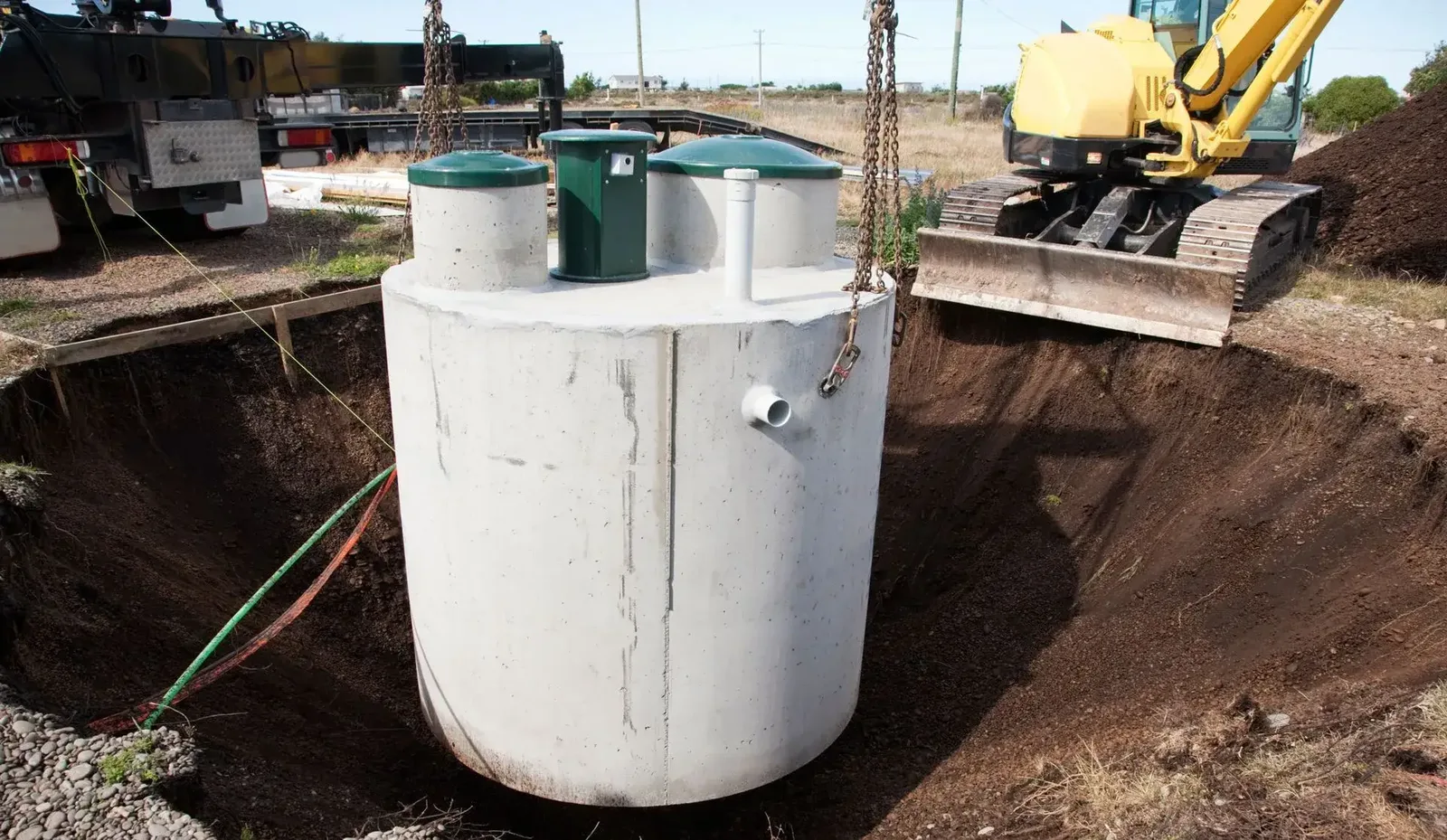
How much does a septic tank installation cost in South Carolina?
Published cost guides put a new septic system in South Carolina at $5,000 to $15,000, with a statewide average near $8,500. Lots in the Midlands and the Sandhills land at the low end of that, around $5,000 to $8,000. Soil, bedroom count, system type and access move the number more than anything else.
Every figure on this page comes from published cost guides and state fee schedules. None of it is a price from us. We put a number on septic system installation across the Midlands after we have seen the lot, and that visit costs you nothing.
What do the published guides say a new system costs?
Three guides that publish their own figures put a new system in the same band. Fixr puts septic tank installation at $4,500 to $9,000 with a $6,100 national average. Today’s Homeowner puts the average at $8,011. Septic & Well Pro, which publishes a South Carolina page, puts the state at $5,000 to $15,000 with an $8,500 average.
The spread inside those ranges is almost all system type. A conventional system is a septic tank feeding a drain field, which the EPA describes as a trench or bed set in the soil. That is the cheapest thing a lot can be permitted for. When the ground will not take water that way, the design moves to a chamber system, a mound system or an aerobic unit, and the price climbs.
| System type | Published cost range | Source |
|---|---|---|
| Conventional gravity system, South Carolina | $5,000 to $9,000 | Septic & Well Pro |
| Conventional system, national | $2,000 to $10,000 | Fixr |
| Chamber system, national | $3,500 to $10,000 | Fixr |
| Engineered system on slow clay, South Carolina | $8,000 to $15,000 | Septic & Well Pro |
| Mound system, national | $10,000 to $20,000 | Fixr |
| Aerobic treatment unit, national | $10,000 to $20,000 | Fixr |
| Mound or aerobic on high water table, South Carolina | $10,000 to $20,000 | Septic & Well Pro |
What does a septic system cost around Columbia?
Septic & Well Pro puts Midlands and Sandhills installs at $5,000 to $8,000, the low end of the whole state range. The reason is the ground under the Columbia area. The same guide points out that Richland and western Lexington counties straddle the Fall Line, so soil can change from one side of a road to the other.
That matters to your bid more than the zip code does. A lot out toward Edmund or Gaston in loose Sandhills dirt usually takes a conventional system. A lot northwest of the river in heavy red clay may need a bigger field or a different design. Above the Fall Line, SCDES says the inspector brings a backhoe to open the ground for the soil evaluation, since a hand auger will not get through.
What size septic tank does South Carolina require?
Regulation 61-56 sets the floor. No septic tank may be installed in South Carolina with a net liquid capacity under 1,000 gallons, and that size serves a home of four bedrooms or fewer. Each bedroom past four adds 250 gallons. A five bedroom home needs 1,250 gallons, and a six bedroom home needs 1,500.
National guides list a 750 gallon tank for a two bedroom house. South Carolina does not allow one that small, so a two bedroom house here still gets a 1,000 gallon tank. Your permit names the size, and the tank has to match it.
| Bedrooms | Minimum tank, Regulation 61-56 | Published installed cost | Source |
|---|---|---|---|
| 2 | 1,000 gallons | $1,500 to $3,000 | Regulation 61-56, Fixr |
| 3 | 1,000 gallons | $3,000 to $7,000 | Regulation 61-56, Fixr |
| 4 | 1,000 gallons | $7,000 to $12,000 | Regulation 61-56, Fixr |
| 5 | 1,250 gallons | $12,000 to $20,000 | Regulation 61-56, Fixr |
How does the SCDES permit and inspection work?
The permit comes from SCDES rather than from the county building department. The application fee is $150, paid with the application. An inspector evaluates the site, and if the lot works for a conventional system the agency issues a permit to construct. Without that permit, your county will not be able to issue you a building permit.
Lexington and Richland counties are both worked out of the SCDES Columbia office, along with Fairfield and Newberry, at (803) 896-0620. A permit to construct stays good for five years. At the back end of the job, someone has to set a time with SCDES for the inspection of the septic system before it is covered. Covering a system that has not had that inspection is a violation of the regulation, so the trenches stay open until the state looks at them.
What moves the number on a Midlands lot?
Soil sets the system type, and system type sets most of the price. Bedroom count sets the tank size. After that it comes down to field length, access, clearing and the run from the house. On the published South Carolina figures, the jump from a conventional system to a mound system starts at $5,000, and the soil makes that call.
Soil. Clemson Extension puts the water a coarse sandy soil holds at 0.05 inches per inch of depth, against 0.17 inches for clay. Clay soils drain slowly and hold more water. Slow ground needs more field, or a design that does not rely on the native soil at all.
Tank size. The permit names it off the bedroom count. A bigger tank costs more and needs a bigger hole.
Field length and type. A conventional field is perforated pipe set in lined trenches. A chamber system uses a run of connected chambers instead, and the EPA calls the easier build its main advantage. A mound system lifts the field above the natural ground, which the EPA lists as the answer for shallow soil or high groundwater.
Access and distance. A tank 30 feet off the back door is a short pipe run. A tank 150 feet out past a fence line means a longer trench and more pipe.
Clearing. On a wooded lot the trees and stumps come out before the dig starts. Fixr puts clearing prep at $1,600 to $8,000, and Today’s Homeowner puts it at $1,200 to $4,800. We handle clearing the wooded part of a lot with our own dozers on the same trip.
The dig itself. The tank hole, the field trenches and the sewer line from the house are all the excavation side of the job. Full size machines get through red clay faster.
What does it cost to replace a drain field or an old tank?
Replacement runs a wider range than a new install, because what comes out matters as much as what goes in. Fixr puts replacing a leach field at $2,000 to $20,000 and a new drain field at $3,500 to $11,000. Bob Vila puts a tank and drain field replacement at $6,000 on average.
| Line item | Published range | Source |
|---|---|---|
| Drain field, new install | $3,500 to $11,000 | Fixr |
| Leach field replacement | $2,000 to $20,000 | Fixr |
| Tank and drain field replacement | $6,000 average | Bob Vila |
| 1,000 gallon concrete tank, tank only | $800 to $1,250 | Fixr |
| Concrete tank material | $700 to $2,000 | Today’s Homeowner |
| SCDES application fee | $150 | SCDES, Regulation 61-56 |
The old system is its own line on a replacement. A tank that has to come out is a dig and a lift. When a home is coming off a lot, the existing tank has to be found and marked first, which is part of removing a mobile home from the property. A customer put it plainly in her review of a double wide teardown we did: “Even brought in fill to level the area out. Marked the septic system as required.”
Can you install your own septic system in South Carolina?
Regulation 61-56 has a narrow allowance for this. It says a person may construct or repair an onsite wastewater system for personal use at their own residence. The permit to construct, the $150 application fee and the SCDES inspection before cover all still apply the same way.
What the allowance does not change is the work. A tank hole, 100 feet or more of trench at a set depth, a level tank and the finish grade over a new field all take a machine. Rules about who may do that work for someone else sit in the same regulation, so call the SCDES Columbia office before you plan around any of it.
How do you get a real number for your lot?
Septic work is one of the few jobs where the ground writes the price, and nobody knows the ground until the site evaluation is back. About 30 percent of South Carolina households run on a septic system, and SCDES took in 17,336 septic applications in a single year.
For our septic tank installation work we read the permit design first, dig the tank hole and the trenches with full size excavators, and leave the lot graded once the state has signed off. Estimates are free, so call (803) 796-4727 and tell us where the lot is.