
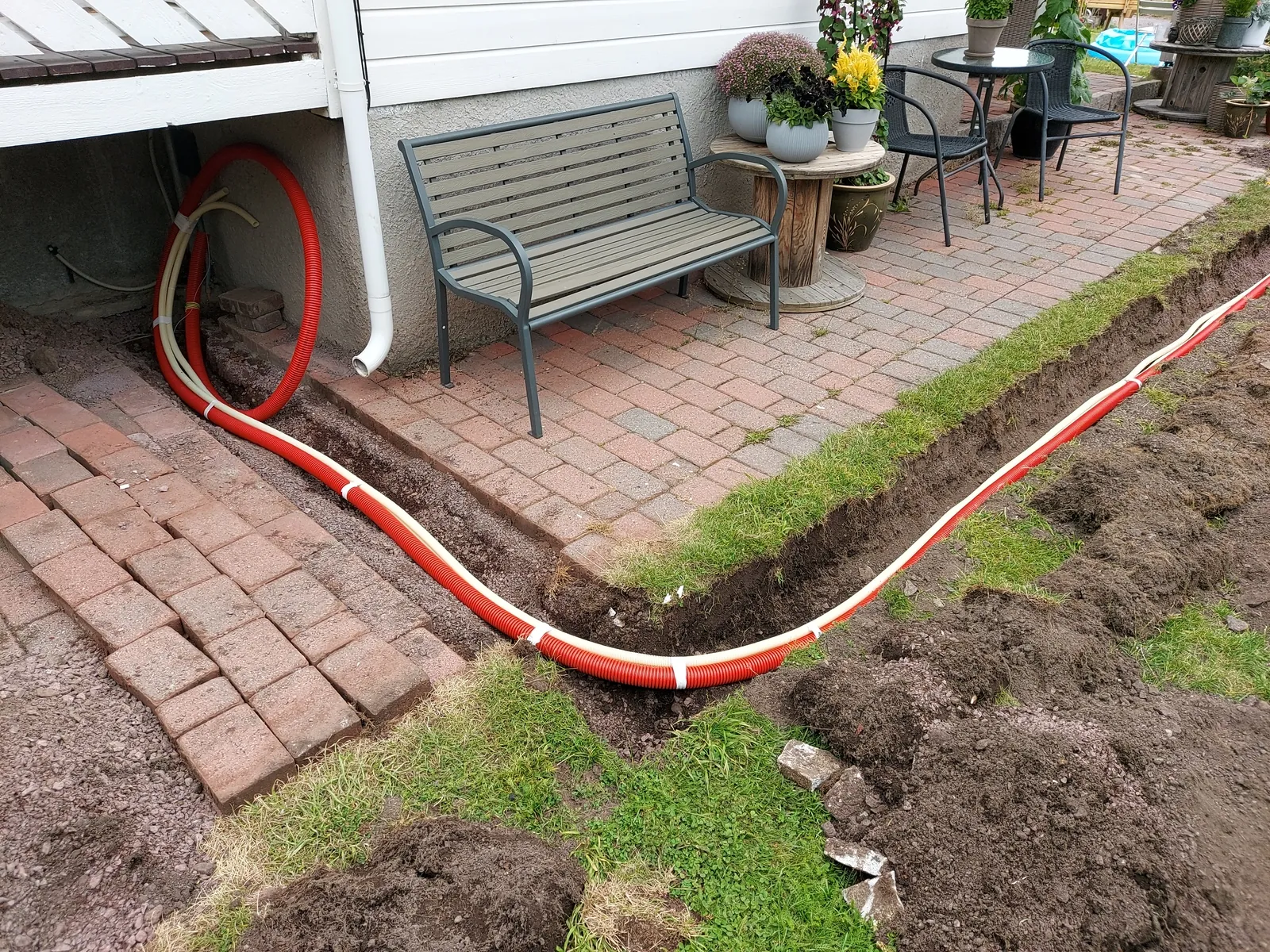
How much does trenching cost in South Carolina?
Published cost guides put professional trenching at $5 to $12 per linear foot for a standard dig. At those rates, a 100 foot trench for a water line or conduit comes to about $500 to $1,200. Angi puts harder digs at $13 to $40 per foot. The pipe, the wire and the trade’s work cost extra.
Every figure here comes from national cost guides and from state and federal rules. Your ground moves the final number. We look at the run on site before we price trenching services around West Columbia. The estimate is free.
What do cost guides say trenching costs per foot?
HomeGuide and Angi both put professional trenching at $5 to $12 per linear foot. Angi puts trenching labor around $5.75 a foot, with equipment adding $3 to $5 a foot. When obstructions, difficult soil or lengthy digging get involved, Angi’s range climbs to $13 to $40 per foot.
Angi notes that most contractors quote trenching per 100 linear feet. The table sorts the published ranges by what the trench is for.
| What the trench is for | Published range | What the figure covers | Guide |
|---|---|---|---|
| Any trench, standard dig | $5 to $12 per foot | The dig | HomeGuide, Angi |
| Any trench, harder dig | $13 to $40 per foot | Obstructions, difficult soil or lengthy digging | Angi |
| Electrical lines | $400 to $1,200 per 100 feet | The trench for the line | Angi |
| Power to a shed, garage or shop | $10 to $25 per foot | Underground line, not the wiring inside the building | HomeGuide |
| Underground electrical project | $600 to $2,100 | Trench and installation | Angi |
| Water line installation | $25 to $200 per foot | Labor, materials and municipal fees | HomeGuide |
| New water line | $1,700 to $3,000 | Trench, with the line connected to the meter | HomeGuide |
| Water lines | $800 to $3,000 | Trench and installation | Angi |
| Yard drainage system | $2,111 to $6,775 | Trench and installation | Angi |
Angi’s project figures include both the trench and the installation. Those rows run higher than the dig alone.
A trench for a drainage pipe follows the same per foot math. Storm drains, culverts and yard drainage problems are their own work, covered under yard drainage and culvert fixes. A Google review of one of those jobs reads: “Storm drain repair for apartment complex fixed twice, both required a large excavation.”
What does it cost to run a water line or electric underground?
HomeGuide puts water line installation at $25 to $200 per linear foot, or $1,000 to $6,000 and up. Angi puts a city water connection at $1,000 to $6,000. For power, HomeGuide puts an underground run to a shed, garage or shop at $10 to $25 per foot. Angi puts power to land at $5 to $15 per foot.
Those totals cover far more than the dig. HomeGuide’s water line range covers labor, materials and municipal fees. Angi’s $800 to $3,000 for water lines includes the cost of the trench.
For power, HomeGuide lists trenching at $5 to $12 per foot as one part of the job. An electrician charges $50 to $130 an hour to install the meter socket and pull the lines through the conduit. The power company installs the meter and completes the connection.
HomeGuide’s shop figure runs $500 to $3,800 for 50 to 150 feet of underground line. That figure leaves out the wiring inside the building.
Angi notes that many utility companies and specialists require that they handle the trench digging themselves. HomeGuide notes that most electricians do not dig trenches themselves and hire out the trenching for conduit. Ask each bid who digs and whether the trench is in the price.
We dig for the line, to the depth, width and grade that the plan or the trade calls for. We keep the walls safe while the line goes in. The licensed plumber, electrician or utility sets, connects, tests and permits the line. Then we close the trench back up and compact it in lifts.
What moves the cost of a trench in the Midlands?
Length sets the base, because guides price trenching by the foot. Depth and width decide how much dirt comes out of each foot. Midlands soil and roots move the number from there. So do a concrete drive in the path, room for a full size machine, the dug dirt and the lawn.
HomeGuide notes that most residential trenches are less than 5 feet deep. Angi says a trench deeper than five feet adds the extra cost of shoring or protective barriers. The plan, the trade and the utility set the depth, and we dig to it.
The ground changes fast around Columbia, on the fall line between the Piedmont and the coastal plain. One lot digs loose and sandy, and the next is heavy red clay that holds water. HomeGuide notes that trenching costs less in soft, loose soil and more in hard clay.
Most of Lexington County sits in the Sandhills, where soils drain very fast. A sandy trench wall can dry out and slough. In a dry spell, the clay can bake into a brick-like hardpan that digs slowly.
Wooded lots put roots and stumps in the line. Angi lists obstructions among the reasons a dig climbs toward $13 to $40 a foot. A large stump in the path has to come out first, and that time shows up in the price.
A concrete drive or walk across the route adds a step. HomeGuide notes that some trenching means breaking through concrete when a driveway or patio crosses the path. That strip comes out first through concrete breakout for drives and walks.
Our full size CASE excavators handle long runs and deep cuts. They need a clear path to the trench line. A gate or a fence in the way gets sorted out at the estimate. Wider digs than a trench fall under excavation for site digs and slab cut outs.
Every foot of trench leaves a pile of dug dirt. Most of it goes back in, closed back up and compacted in lifts. Any extra is spread on site or loaded out, and that shows up in the price.
A compacted trench still leaves a strip of bare dirt across the yard. Angi notes that new sod takes about 30 to 45 days to take root.
What South Carolina rules apply when you dig a trench?
South Carolina law puts the SC811 locate request on the excavator. Notice goes in 3 to 12 full working days before digging, not counting the day it is given. OSHA requires a protective system in a trench 5 feet deep or more. Work in a state road right of way needs an SCDOT encroachment permit first.
A homeowner or an excavator can call 811 or submit a locate request online with SC811, the state’s notification center. On our jobs, the SC811 locate request goes in before the first cut.
A notice expires 15 working days after the start date it names. Digging past that date needs a new notice. One notice covers no more than a quarter mile, or five adjoining addresses, whichever is less.
Each marked line has a tolerance zone. It runs half the line’s diameter plus 24 inches on either side of the marked center line. The law bars machine digging inside that zone except under the conditions it lists. Careful hand or non-invasive work exposes the line first.
OSHA’s protective system for a trench 5 feet deep or more can be sloping, benching, shoring or a trench box. A shallower trench can skip it only if a competent person sees no sign of a cave-in. Any trench 4 feet deep or more needs a ladder, ramp or stairway within 25 feet of travel. Dug dirt and equipment stay at least 2 feet back from the edge.
A trench along or under a state road shoulder sits in SCDOT right of way. Any work there needs an encroachment permit before it starts, and SCDOT charges no fee for that permit. The plumber or electrician pulls the permit for the line itself, so confirm that fee with your county or city.
Is renting a trencher cheaper?
HomeGuide puts trencher rental at $100 to $200 or more per day for a do it yourself dig. Angi warns that rental days add up quickly if the project takes longer than expected. Anyone who digs, homeowners included, must put in the SC811 locate request before breaking ground.
How do you get a trenching estimate around Columbia?
Start with the route, the length and what the line is for. Know which trade sets the line and how deep the plan calls for. We look at the run on site. We check the soil and anything in the way, then give you a number before any digging starts.
Dirt Cheap is a family and woman owned demolition and site-work contractor. Our shop sits on Edmund Highway in West Columbia. We work about 50 miles around it, including Lexington, Irmo, Sumter, Aiken and Orangeburg. Estimates are free, so call (803) 796-4727 and tell us where the trench needs to run.