How much does it cost to demolish a house in South Carolina?
Published 2026 cost guides put house demolition at $4 to $17 per square foot, with a national average near $10,000 to $15,800 for a typical single family home. Columbia area estimates come in a little lower, at $9,000 to $19,000 depending on size and whether there is a basement. Size, foundation, materials and disposal move the number.
Every figure on this page is market data from published cost guides and government fee schedules. None of it is a quote from us. We price house and mobile home demolition after we see the property, and that visit is free.
What do the cost guides say a teardown costs?
Four national guides that publish their own numbers agree on the shape of the range. Fixr puts a full house demolition at $7,500 to $15,000 with a $10,000 average. HomeAdvisor and Dropcurb both put the normal range at $6,000 to $25,000. DemoProsPlus puts a 2,000 square foot house at $10,000 to $34,000.
The per square foot number is what matters for your house. Fixr says $5 to $10. HomeAdvisor and Dropcurb say $4 to $17. Older wood framed houses sit at the bottom of that range. Newer houses with basements sit at the top.
| House size | Fixr | HomeAdvisor | Dropcurb |
|---|---|---|---|
| 1,000 sq ft | $5,000 to $10,000 | not listed | $4,000 to $10,000 |
| 1,500 sq ft | $7,500 to $15,000 | $6,000 to $25,500 | $6,000 to $15,000 |
| 2,000 sq ft | $10,000 to $20,000 | $8,000 to $34,000 | $8,000 to $20,000 |
| 2,500 sq ft | $12,500 to $25,000 | $10,000 to $32,500 | $10,000 to $25,000 |
| 3,000 sq ft | not listed | $12,000 to $51,000 | $15,000 to $35,000 |
What does house demolition cost in the Columbia area?
HomeBlue publishes a Columbia, SC estimate of $9,000 to $19,000 for house demolition across all sizes. A house under 4,000 square feet with no basement runs $9,000 to $11,400. The same house with a basement runs $10,900 to $14,300. Over 4,000 square feet with a basement, the estimate climbs to $14,700 to $19,000.
Those are modeled numbers from a national aggregator, not local invoices. They are still the most useful published figures for the Midlands. Two things about them fit what we see on the ground. Most houses around Columbia, Lexington and Cayce sit on a slab or a crawlspace, not a basement. That keeps Midlands teardowns near the low end of the national range. And the basement premium on HomeBlue’s own numbers is about $1,900 to $2,900, which is what filling a hole and hauling extra concrete costs.
HomeBlue also lists a garage teardown in Columbia at $2,400 to $3,800, concrete slab removal at $4 to $5 per square foot, and a swimming pool removal at $7,100 to $11,400.
What moves the price up or down?
Size sets the base. Everything else moves it from there. Here is what a demolition contractor is actually pricing when the estimate comes back.
Foundation. A slab breaks out and hauls as clean concrete. A crawlspace has block walls and piers to pull. A basement means far more concrete and a hole that needs fill. Fixr puts basement removal and fill at $5,000 to $25,000 on its own. Dropcurb prices a full demo with foundation removal at $6 to $15 per square foot, against $4 to $10 without it.
Construction type. A wood framed house comes apart faster than brick. Brick and block weigh more, which shows up at the landfill scale.
Hazardous materials. Asbestos is the surprise cost. Fixr says asbestos can push a teardown to two or three times the normal price. Testing runs around $500. Abatement runs $2,000 to $10,000 in the DemoProsPlus guide, or $5 to $20 per square foot in Dropcurb’s. Houses built before 1980 are the risk pool.
Disposal. DemoProsPlus puts debris disposal at 30 to 50 percent of the whole project. That is why the local landfill rate matters more than any national average, and why we cover it below.
Utilities. Water, sewer, gas and electric have to be cut and capped before the machine starts. Dropcurb puts utility disconnects at $500 to $2,000 nationally. The utility controls the schedule on this, not the contractor.
Access. A tight lot in Shandon with street trees to protect is a slower job than a rural lot off Platt Springs Road with room to swing the boom.
What are the real permit and landfill fees around West Columbia?
This is where the Midlands differs from the national guides, and the numbers come straight from the county and city schedules.
| Fee | Amount | Source |
|---|---|---|
| Demolition permit, unincorporated Lexington County | $21 | County fee schedule effective July 1, 2026 |
| Demolition permit, City of West Columbia, residential | $50 | City fee schedule as published |
| Demolition permit, City of West Columbia, commercial | $100 | City fee schedule as published |
| Mixed construction and demolition debris, Edmund Landfill | $38 per ton | County solid waste fees effective July 1, 2026 |
| Clean concrete, Edmund Landfill | $20 per ton | Same schedule |
| Loads not properly separated, Edmund Landfill | $56 per ton | Same schedule |
| Metal, Edmund Landfill | $28 per ton | Same schedule |
Two notes on those numbers. The West Columbia schedule the city links today is dated for fiscal year 2020 to 2021, so confirm it with the Building Department before you count on it. And the City of Columbia does not publish a demolition permit fee online. Its Development Center packet lists what to submit, not what it costs.
The landfill table is the useful part. A house teardown does not qualify as free residential drop off. Lexington County’s own schedule says all waste from contractors and demolition must go to the landfill and is charged. So clean concrete at $20 per ton against mixed debris at $38 per ton, and a $56 per ton penalty for a mixed load, is real money across a whole house. We sort the concrete, metal and mixed debris as the structure comes down for that reason. It leaves on our own trucks, and the sorting shows up as a lower disposal line on the bill.
Do you need an asbestos survey before a teardown in South Carolina?
For most single family homes, no state survey is required, but the local permit may still ask for one. The agency here is SCDES, the South Carolina Department of Environmental Services, which took over environmental programs from DHEC on July 1, 2024. Anything still calling it DHEC is out of date.
SCDES exempts the demolition of a private residence with four or fewer units from its asbestos notification unless one of five conditions applies. The demolition is part of a larger commercial or public project. It involves multiple houses in a compact area under one owner, like a city clearing a block. The house sits on an installation such as a base or campus. The house is being burned for fire training. Or the house was ever used for non residential purposes.
That last one catches converted houses. A former daycare, office or shop needs the full survey and a ten working day notification before it comes down. Where the exemption does not apply, all asbestos containing material has to be removed first, and the notification goes in through SCDES ePermitting with the building inspector’s report attached.
The City of West Columbia adds its own step. Its building permit application says an asbestos survey or a form from SCDES must be attached to any demolition permit. So even an exempt house in West Columbia needs that paperwork in the packet.
How does the demolition itself go?
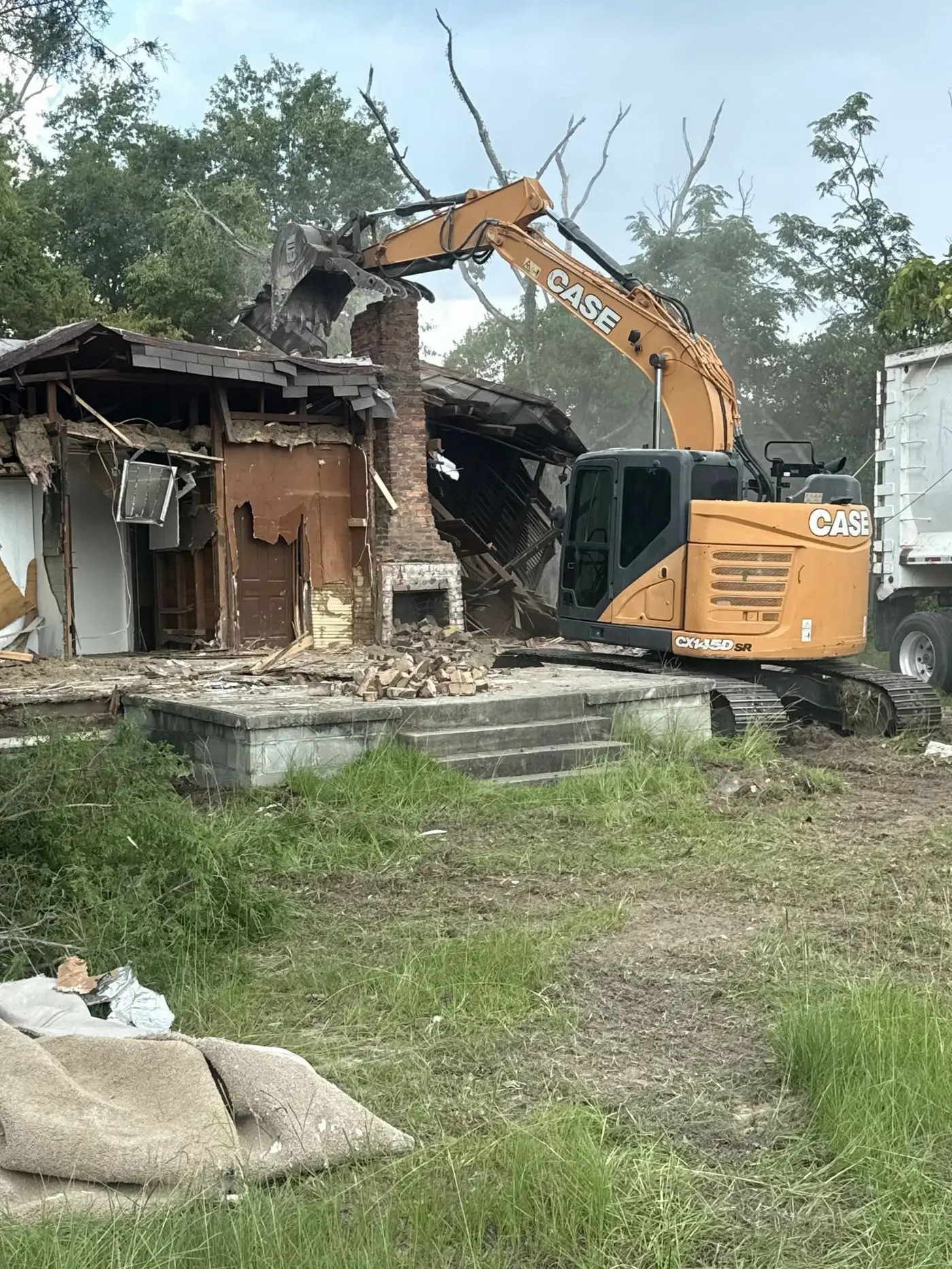
A mechanical teardown of a normal house takes two to five days once permits are in hand. The excavator works from one end, the walls and roof come down into the footprint, and the debris gets loaded into trailers as it piles up. Then the slab or foundation gets broken out and loaded. The hole gets filled and the lot gets graded so it drains. If the site needs more than a rough grade, grading and pad prep for the next build happens with the same machines.
Partial demolition, like taking down a wing or a garage, runs one to three days. Hand deconstruction to salvage lumber and fixtures takes two to four weeks and costs $10 to $30 per square foot in the guides, which is why almost nobody chooses it for a house that is past saving.
Is it cheaper to tear down or remodel?
It depends on what is left to save. Interior gutting runs $2 to $8 per square foot in Dropcurb’s guide, while a full teardown runs $4 to $10 before the foundation comes out. A gut job leaves you a shell that still has old framing, old wiring and an old foundation. A teardown gives you a clean lot. When a house has a failed foundation, fire damage or years of water in the walls, the remodel math usually loses. A fire damaged house is the clearest case.
If you own a strip of commercial property or an old church rather than a house, the process and the SCDES rules change. Our commercial demolition page covers that side.
What should you ask before you sign a demolition bid?
Ask whether the foundation comes out or stays. Ask whether the price includes loading, hauling and landfill fees. Ask who handles the utility disconnects and the permit. Ask what size excavator is coming, because a two story brick house is not a mini excavator job. And ask what the lot looks like when they leave. Dirt Cheap leaves it graded, filled and clean, with the debris gone on our own trucks. Call (803) 796-4727 and we will come look at the house and put a written number on it.